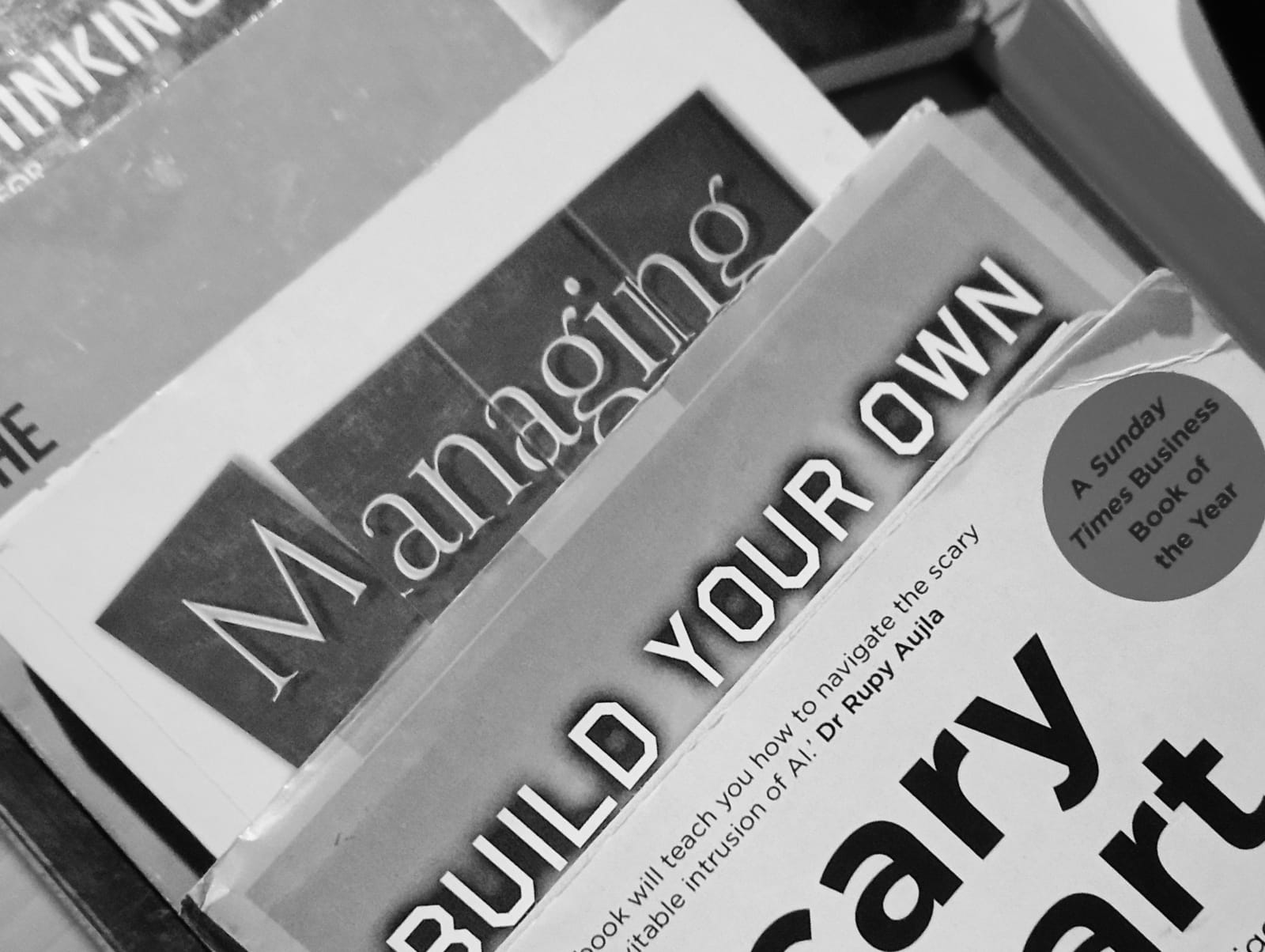

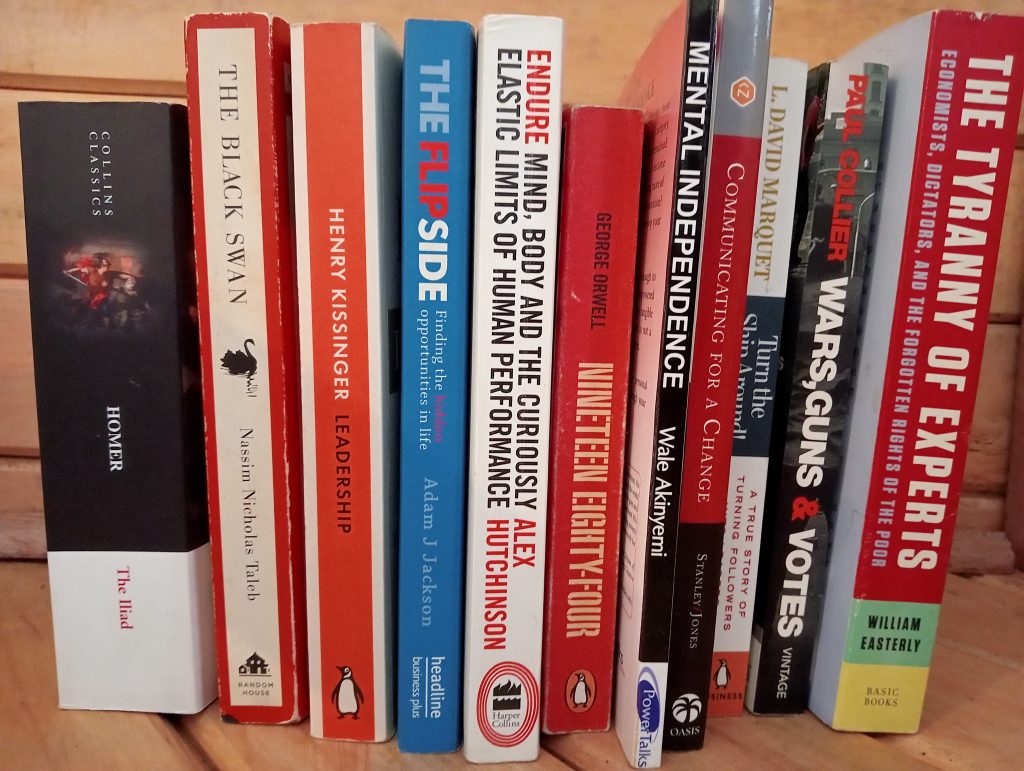


Today is 28th December 2025, it’s that quiet week between the holidays, when the world slows down and we lose count of which day of the week it is. I return to this annual ritual to share with you what I chose to wrestle with when no one was watching; books I have read during the year.
Some of the titles were uncomfortable and especially how truth presented itself; quiet, firm, unembellished and with a certain texture: it doesn’t hype, it doesn’t absolve, and it often rebukes. Throughout the year, I have gleaned many lessons and the key one is this: Excellence requires sustained effort, an iron will. Success has scars; many scars!
This year has been a particularly emotive one for me; I lost my dad in June and truth be told I’m yet to overcome the grief; that empty void that visits me every so often and the hopelessness of knowing that I won’t be able to reach out to him; indeed, death does sting. So, this year I choose to close with a dirge in honour of my papa; you will find it at the end.
Leadership – Henry Kissinger
Henry Kissinger’s legacy is not black and white, sometimes we say tripe is also meat; it is worth distilling the book apart from the man; after all, this is not a biography of Henry Kissinger. The book’s true focus is on exceptional individuals: Charles de Gaulle, Konrad Adenauer, Lee Kuan Yew, and their contemporaries, and in that regard, it is deeply worthwhile.
What binds the leaders profiled in the book is a common denominator that transcends ideology or geography. They were visionaries anchored in reality, patriots willing to make unpopular decisions, brave in uncertainty, and highly skilled in the craft of state-building. They understood that nations are not accidents but deliberate political constructions, requiring discipline, sacrifice, and moral seriousness over time. Above all, they treated leadership not as entitlement, but as stewardship; an obligation to shape institutions strong enough to outlive them.
These biographies expose what is missing, a shared culture, an intolerance for mediocrity in both private and public service, and a people patriotic to the bone, fully committed to the long-term good of the community. The contrast is painful and clarifying. We suffer from a leadership deficit, and it is glaring. Recommended reading to those aspiring to mirror an Asian tiger miracle in Africa (read Singapore).
Communicating for a change – Andy Stanley and Lane Jones
I picked this book at a book sale in my local church, and I’m glad I did. Andy Stanley and Lane Jones argue that effective communication is not about how many points you make, but about whether anything actually changes. The authors begin with a simple but unsettling truth: we don’t live our lives by points; we live by emotions. Rather than throwing mud and seeing what sticks, they urge communicators to abandon cluttered outlines and focus on a single powerful idea; because while points go on paper, one clear idea has a way of penetrating the heart.
The discipline they propose is exacting but humane: pick one idea, principle, or application and build everything around it. One point. One question. One application. Strip away alliterated lists, take one simple truth, and lodge it in the listener’s heart. What’s at stake is not eloquence but action, because every listener is one decision away from moral, financial, or marital ruin.
Communication that changes lives is measured by what people do afterward. Plan the journey with the end in mind, and before stepping up to speak, ask yourself: what is the one thing I want my audience to know, and what do I want them to do about it? If you don’t have those answers, the authors say plainly, pass the mic. Recommended reading for speakers who want their audience to take action.
The Tyranny of Experts – William Easterly
William Easterly asks an uncomfortable 21st century question: after billions in hard currency have been poured into developing countries, why is there so little to show for it? His answer is a scathing attack on the hypocrisy embedded in what passes for development economics, beginning with its most revered institution; the World Bank. The author offers newcomers to international politics a sharp education in the historical, theoretical, and world-order reasons the system is broken, tracing the “original sin” to the Bank’s founding articles, which deliberately disavowed freedom by insisting it would not be influenced by the character of governments. In doing so, he argues, the system created a landing pad for benevolent autocrats and enabled the triumph of authoritarian development over free development.
Easterly dismantles the seductive idea of the benevolent dictator and the impulse to weaken laws that “slow down” the executive, warning that this road leads to the abyss. There is, he insists, no safer way to impoverish a country than to entrust its enrichment to an unchecked government. Power without constraints becomes abusive power, whereas societies where citizens can assert their rights avoid oppression and accumulate private wealth.
The author notes that the freest societies, are often the richest; not because they have better politicians, but because they have systems that force even the worst political actors to serve the majority through productivity-enhancing policies. In his most damning conclusion, Easterly argues that what institutions like the World Bank truly deny the people of the bottom-half countries is not money, but the most potent development tool of all: freedom. This book is highly recommended for anyone who has ever toyed with the idea of a benevolent dictator.
Wars, guns and votes – Paul Collier
The author starts with an interrogation of what unites the world’s most backward, misfortunate, and war-torn societies. Beyond the human misery, they belong to the bottom billion; the scrum of earth. Why are these countries dysfunctional? Collier goes to where the truth lies; a failure to build nation states. The author takes the risk of the all-familiar white saviour moral posturing pontificated by western commentators, but his arguments are cogent and passionate.
Collier argues that ethnic identity in societies of the bottom billion trumps national identity, operating as a form of insurance built on reciprocal obligation. Diversity increases the risk of violence, especially when ethnic and religious divisions compound each other, and armed struggle is development in reverse. He argues that change is hard and fiercely resisted, and that in very poor societies democracy can amplify danger rather than cure it, as votes become frozen in blocs of ethnic identities; politics then misses it most potent kick – ideology. The author is not anti-democracy: he argues that democracy is a force for good only when it is more than a façade.
Successful states are built through a painfully slow process of formation, where national identity which is a political construction, gradually replaces ethnic loyalties. This, you will agree with me is not the work of political kingpins and wheeler-dealers. I’m afraid to conclude that at the rate which systems of governance are desecrated on in poor countries, suffice is to say that shall be in the trenches a little longer. Recommended reading to any patriot.
Turn the ship around – David Marquet
David Marquet recounts his experience as a U.S. Navy captain tasked with leading the USS Santa Fe, a nuclear submarine at the very bottom of the barrel. Morale was low, performance poor, retention weak, and safety violations common; every worthwhile tracker was returning a negative. Marquet candidly describes his early struggles and the realization that conventional leadership was failing. When he shifted from giving orders to requiring his crew to own both the problem and the solution, they began to see themselves as vital links in the chain of command rather than passive followers.
The book challenges the deeply entrenched leader–follower model that dominates how we study and practice leadership. While that model succeeded in a world of physical labor, Marquet argues it is ill-suited for today’s intellectual work, where low motivation results in people doing only what is absolutely necessary. What he proposes is not a nuanced adjustment but a fundamentally different way of doing business: the leader–leader model. Grounded in trust and captured in Stephen Covey’s idea that leadership is communicating people’s worth and potential so clearly that they see it themselves, Marquet’s central message is simple and radical: establish trust, distribute authority, and recognize that we can all be leaders, and that organizations work best when we are all leaders. Recommended reading to all people managers.
1984 – George Orwell
A dark, melancholic work of fiction that drives relentlessly toward hopelessness and despair, leaving me at the final page with a sinking feeling in my stomach and a genuine wish that I had not read through the book. George Orwell delivers a terrifying, nerve-gripping experience; so unsettling that, had I known the emotions waiting at the end, I would never have read it. And yet, I am glad I did, an oxymoron that captures the book’s power. At its core lies a haunting interrogation of freedom, knowledge, and truth: who decides what is true or false, and who guards the thin line between freedom and slavery?
Orwell’s genius lies in showing how power sustains itself through fear, repression, and the manipulation of language. He demonstrates the potency of verbs and how a ruling caste can keep the masses inebriated on nonsense, stripped of independent thought, in a world where power is pursued as an end in itself and never relinquished. Disturbing as the vision is, the book is redeemed by its beautiful prose and Orwell’s formidable command of literature, which makes the descent into darkness as compelling as it is unforgettable. Recommended reading to those who loathe politics of deception.
Endure – Alex Hutchinson
I admire athletes; especially the endurance sports breed, and that in part explains why I picked this book. The author explores the elusive limits of human performance, asking whether endurance is shaped by physical fortitude, good fortune, or the workings of a great mind. He dismantles the idea of a “perfect man” by showing that brain and body are fundamentally intertwined, not in any simplistic way that can be easily explained away, but through the convergence of effort, motivation, and conscious decision-making. Endurance, in this telling, is not merely about muscles or lungs, but about how the mind interprets strain and decides again and again whether to continue.
Drawing from the lived reality of endurance sport, Hutchinson captures its essence with a runner’s truth: “a runner is a miser, spending the pennies of his energy with great stinginess, determined to be broke only at the exact moment the race ends”. Hiking, marathons, cycling, and their related cousins become enterprises of slow-drip torture, where the athlete learns that the will to endure cannot be pinned to any single physiological variable. The words in your head shape the feelings in your body, and brushing away mental barriers to unlock true potential, and that is a lesson that extends far beyond sport; into every facet of life. Recommended reading to especially entrepreneurs who are boot strapping and also the very many marathon wannabes.
The flipside – Adam Jackson
The flipside is the other side of a problem. Adam Jackson argues that the events of our lives do not, by themselves, determine our future happiness or success. What matters more is our continued ability to control our thoughts and beliefs, because mastery of mindset is infinitely more powerful than anything that happens to us. Even when faced with seemingly insurmountable challenges, psychological trauma if responded to in the right way can forge stronger character and lead to profound personal growth.
Through bright, witty, and vibrant storytelling, the book traces personal disasters that became life-affirming turning points, moments that triggered change and redirected lives. Jackson observes that people persist through failure only when they are truly sick and tired of being sick and tired, and that human beings are driven primarily by pain and pleasure, with pain the stronger motivator. His conclusion is quietly defiant: refuse to be beaten by circumstances, keep trying despite setbacks, and embrace change as opportunity. Those who do, he suggests, often emerge far richer and more fulfilled. A final lesson, it helps to be an optimist, because optimists tend to win. Recommended reading to those who have undergone a traumatic experience.
Epilogue
Thank you for reading this far, I wish you a safe cross over to 2026. And finally….
A Dirge for My Papa
A feeble, lamentable cry from a son
to a hero slumbering in eternal shade
bursts from the heart,
and torrents from my eyes.
That morning, papa,
when you sunk into the soft arms of sleep
when once we pass, the soul returns no more.
The fate foredoomed that waits every man from birth.
And with thick succeeding sighs
there on the spot which you pointed to me, interred.
finally gathered with your fathers.
You guarded inviolate the weak,
Fixed on the goal,
your eyes fore ran the course,
not with strength
but with great judgement.
You nourished with great care,
and with words encouraged,
poured your soul, to the three indefensible.
Forever grateful that you raised me, papa.
May for your honour
nobler work rise.
Sleep, papa, sleep,
till that morning on the golden shore,
we shall meet.
One day, man shall beat cancer.
That day will not erase loss but we shall toast.
Sleep, papa.
CPA Francis Mungai
The author is Head of Client Services at FH Consulting LLP